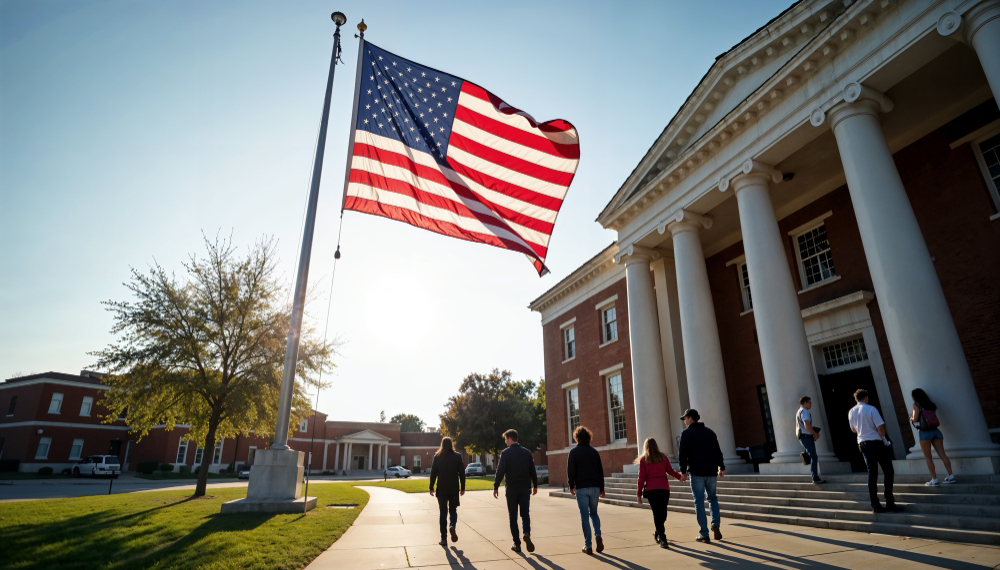
Thousands of foreign students gaze at their laptops each year, daydreaming of strolling across an American university campus, such as Harvard, Stanford, or MIT, and wondering if the expense would ever cease to be the major concern. And to be honest, that’s a very legitimate worry. The cost of studying in the US is high. The fact that there is more money available than most students ever search for, however, is something that is often overlooked.
The United States remains the world’s top destination for international students, and American universities, the U.S. government, and private organizations collectively give away billions of dollars each year to help talented students from around the world make that dream real. The problem isn’t a lack of money — it’s a lack of information.
This guide changes that. This is your ultimate guide to USA scholarships for overseas students in 2026, regardless of whether you’re an undergraduate student, a master’s candidate, or a PhD researcher. We’ll go over who is contributing what, how to be eligible, how to apply wisely, and how to steer clear of the errors that silently destroy most applications.
Why USA Scholarships for International Students in 2026 Are More Competitive Than Ever
The competition is genuine; let’s not sugarcoat it. The number of students vying for the same scholarship funds has increased in tandem with the record-breaking number of overseas students applying to American universities in recent years.
But competition cuts both ways. More institutions are also offering more awards. According to EducationUSA, the U.S. Department of State’s official resource for international students, there are currently over 271 financial aid opportunities open to international applicants across universities ranging from Carnegie Mellon to the University of Connecticut.
The students who win these awards aren’t necessarily the ones with the highest GPAs. They’re the ones who start early, apply strategically, and tell a compelling story. More on that later.
Types of USA Scholarships for International Students 2026
Understanding the landscape is step one. USA scholarships for international students in 2026 broadly fall into four categories:
1. U.S. Government-Funded Scholarships
These are fully funded, prestigious, and highly competitive. They’re administered through U.S. federal agencies and are typically aimed at graduate-level students.
2. University-Specific Scholarships
Individual universities offer their own funding, ranging from partial tuition waivers to full-ride packages that cover tuition, housing, living stipends, and health insurance.
3. Private and Corporate Scholarships
Foundations, corporations, NGOs, and professional associations offer targeted awards — often for specific fields of study, nationalities, or demographics.
4. Home Country Government Scholarships
Many governments sponsor students to study abroad. If you’re from India, South Korea, Mexico, Brazil, or Nigeria, among dozens of others, check whether your government has an outbound scholarship program before looking elsewhere.
Top USA Scholarships for International Students 2026: The Complete List
Fulbright Foreign Student Program — The Gold Standard
If you’ve done any research at all, you’ve heard of Fulbright. And for good reason. The Fulbright Foreign Student Program is arguably the most recognized fully funded scholarship for international graduate students in the world. It covers full tuition, a living stipend, accommodation, airfare, and health insurance — and it opens doors that almost nothing else can.
Here’s what makes Fulbright unique: it’s not just about academic excellence. The selection process evaluates your potential to represent your country in the United States and your commitment to going back and creating impact at home. It’s a bilateral cultural exchange program at heart.
Key highlights:
- Open to graduate students and young professionals
- Covers tuition, living expenses, travel, and health insurance
- Available in all fields except medicine
- Apply through the Fulbright Commission or U.S. Embassy in your home country
- Highly competitive, but deeply worth pursuing
Pro tip: Applications are evaluated on the quality and feasibility of your project proposal — not just your grades. A clear, specific, and well-justified research proposal can set you miles apart from other candidates.
Yale University Scholarship — Ivy League Access Without the Ivy League Price Tag
Yale doesn’t just accept the world’s best students — it funds them. The scholarships of Yale for international students can range from a few hundred dollars to over $70,000 per year, with the average need-based award exceeding $50,000. These are available at undergraduate, master’s, and PhD levels.
Yale’s approach to financial aid is largely need-based, which means your family’s income matters just as much as your test scores. If your household income is low, Yale’s financial aid office may cover the bulk of your education cost entirely.
Stanford University Scholarship — STEM and Beyond
The Stanford University Scholarship for international students covers full tuition fees, traveling allowance, living allowance, and academic expenses at the master’s and PhD level. Stanford is particularly strong in engineering, technology, business, and the sciences, but offers opportunities across disciplines.
Getting into Stanford is hard. Getting a scholarship there is harder. But for PhD programs in particular, many students are automatically considered for funding once admitted — which means the admission letter and the funding offer often arrive together.
AAUW International Fellowships — For Women Pursuing Graduate Study
The American Association of University Women (AAUW) offers fellowships of between $20,000 and $50,000 for international women pursuing full-time graduate or postdoctoral study in the United States. This is one of the most respected private scholarship programs in the country for women in academia.
Eligibility:
- Open to women who are not U.S. citizens or permanent residents
- Must have earned the equivalent of a U.S. bachelor’s degree by the application deadline
- Requires a history of outstanding achievement in your field
Hubert H. Humphrey Fellowship Program — For Experienced Professionals
This one is different. The Hubert Humphrey Fellowship is not a degree program — it’s a 10-month non-degree academic and professional development experience in the United States. Although the funding doesn’t support degree qualifications, students are able to study and develop their knowledge at academic institutions across the nation.
It’s ideal for mid-career professionals from the developing world who want to deepen their expertise and build networks in their field. Think of it as a sabbatical with a scholarship.
Facebook (Meta) Fellowship Program — For Doctoral Researchers in Technology
The Facebook Fellowship Program is a fully funded scholarship for doctoral research studies that covers two years of study and fees, an annual stipend, and conference travel aid at an accredited university in any country. If your PhD sits at the intersection of technology, artificial intelligence, or computing, this is one of the most lucrative private awards you can pursue.
University of Minnesota Fellowship
The University of Minnesota Fellowship is a fully funded scholarship for international students at the master’s level, offering full tuition costs, living expenses, travel, and health insurance. For students targeting research-intensive programs in the Midwest, Minnesota’s fellowship is both generous and relatively accessible compared to Ivy League awards.
University of Memphis International Scholarship
The University of Memphis Scholarship for international students is available for undergraduate and master’s studies, and the scholarship amount covers the difference between international and domestic non-Tennessee resident tuition rates. It may not make headlines like Harvard or Stanford, but for students who want quality American education with strong funding, this is worth a serious look.
USA Scholarships for International Students 2026: Quick Comparison Table
| Scholarship | Level | Coverage | Field | Deadline |
|---|---|---|---|---|
| Fulbright Foreign Student Program | Masters / PhD | Full tuition + stipend + airfare + insurance | All except medicine | Varies by country |
| Yale University Scholarship | UG / Masters / PhD | Up to $70,000+ per year | All | January 1 annually |
| Stanford University Scholarship | Masters / PhD | Full tuition + living + travel | All | December – January |
| AAUW International Fellowship | Masters / PhD / Postdoc | $20,000 – $50,000 | All | November |
| Hubert Humphrey Fellowship | Non-degree | Full funding | Public policy / development | October |
| Facebook Fellowship Program | PhD | 2 years tuition + stipend + travel | Tech / AI / Computing | October |
| University of Minnesota Fellowship | Masters | Full tuition + living + travel + insurance | Research fields | Varies |
| University of Memphis Scholarship | UG / Masters | Partial tuition | All | Varies |
| Rotary Peace Fellowship | Masters | Fully funded | Peace and development | May |
| IIE-SRF Fellowship | Doctoral | Up to $25,000 + insurance | Research | Varies |
How to Find USA Scholarships for International Students 2026: The Best Resources
You don’t have to do this alone. There are several reliable platforms where scholarship listings are regularly updated:
- EducationUSA — The official U.S. State Department resource. Free advisory services are available through U.S. Embassies in most countries.
- Bold.org — One of the most comprehensive private scholarship databases, with data on actual winners that tells you what it really takes to win.
- Scholars4Dev — A curated list specifically for students from developing countries, organized by level and field.
- ScholarshipRoar — Regularly updated listings with step-by-step application guidance.
These platforms are free. Any service that charges you to search for scholarships is, at best, unnecessary — and at worst, a scam. As an international student, scholarship scams are everywhere, and you are a prime target for people trying to take your money. If something asks for payment before you can apply, walk away.
Who Actually Wins USA Scholarships for International Students?
Here’s where things get interesting. According to data from Bold.org, scholarship winners average a GPA of 3.67 — only 0.1 points above the pool average of 3.57. That’s a remarkably small gap. The myth that only students with perfect grades win scholarships simply doesn’t hold up.
More than a third of scholarship seekers on the platform have GPAs below 3.5, and many awards set no GPA floor at all. Scholarships that weigh need, community involvement, or essay quality actively welcome students with 3.0 GPAs and above.
What does this mean for you? Your story matters. Your reasons for wanting to study in the United States, what you plan to do with your degree, and how your background shapes your perspective — these things carry real weight in competitive scholarship processes.
Smart Strategy: How to Maximize Your USA Scholarship Chances in 2026
This is where most students go wrong — they apply to one or two big scholarships and hope for the best. That’s not a strategy. That’s a lottery ticket.
Here’s a better approach:
Build a Layered Scholarship Portfolio
Going after one big $10,000 award is a long shot. Winning three to five awards in the $1,000–$3,000 range is a steadier path. Four median-level wins can total $4,000 — enough for textbooks, a housing deposit, or months of living costs.
The $1,000–$4,999 bracket holds more than half of all scholarship awards. Students who focus here, rather than only chasing top-dollar awards, build a real funding base.
Start at Least 12 Months Before Your Intended Start Date
Most major scholarships — Fulbright, AAUW, Rotary — have deadlines that fall 12 to 18 months before the academic year begins. If you’re planning to start in Fall 2026, you should already be researching and preparing now.
Apply to University-Specific Programs First
Many universities automatically consider admitted students for institutional scholarships. Getting your application in early — and applying to schools known for generous international student funding — significantly increases your odds of receiving an award without a separate application process.
Schools like Berea College in Kentucky, for example, guarantee every admitted student a full-tuition scholarship regardless of nationality. It’s deliberately under the radar, which means less competition.
Write Scholarship Essays That Tell a Specific Story
Generic essays lose. Committees read thousands of essays that sound exactly the same — “I have always been passionate about helping my community and want to pursue a better future.” That’s not a story. That’s a template.
What works: A specific, concrete narrative. The moment you decided what you wanted to study. The problem in your community you intend to solve. The professor at MIT whose research directly connects to your own. Specificity signals seriousness.
Ask for Strong, Specific Recommendation Letters
Weak letters of recommendation kill strong applications. A letter that says “This student was excellent in my class” does almost nothing for you. You want a recommender who can speak to your specific abilities, your intellectual curiosity, and your potential for impact.
Brief your recommenders thoroughly — share your scholarship essays, your CV, and the specific qualities the scholarship is looking for. Make it easy for them to write something powerful.
What USA Scholarships for International Students Typically Cover in 2026
Coverage varies widely, but here’s what fully funded scholarships generally include:
- Full tuition fees — often the largest component, which can run $30,000–$60,000 per year at private universities
- Monthly living stipend — typically $1,000–$2,500/month depending on the city
- Health insurance — often a requirement for maintaining student visa status
- Round-trip airfare — usually covered at the start and end of the program
- Accommodation — either provided directly or covered through the stipend
- Books and academic materials — sometimes included as a separate allowance
Partial scholarships, on the other hand, typically cover tuition only — and sometimes just a portion of it. Always read the fine print.
Important Things International Students Must Know Before Applying
Taxes on Scholarship Funds
Under IRS Publication 519, scholarship money that goes beyond tuition and required fees — used for room, board, or living costs — counts as taxable income for nonresident aliens. If you win $5,000 and tuition is $3,500, the extra $1,500 may be taxed. However, tax treaties between the U.S. and many countries lower or remove this tax — ask your school’s international student office for guidance.
Full-Time Enrollment Requirements
Most scholarships require full-time enrollment status, which aligns with F-1 visa rules — usually 12 credits for undergraduates and 9 for graduate students. Dropping below full-time can put both your scholarship and your visa at risk. Know the terms before you accept any award.
Visa Implications
A scholarship does not guarantee a visa. An F-1 student visa requires proof of enrollment at a SEVP-certified institution and evidence of sufficient financial support. Your scholarship award letter can serve as financial evidence, but the visa application is entirely separate.
Home Country Scholarships: Don’t Overlook These
Many governments fund outbound study for their citizens. India’s Tata Scholarships, Mexico’s CONACYT fellowships, Brazil’s CAPES/CNPq programs, and South Korea’s Korean Government Scholarship Program (KGSP) are all well-known examples.
If you’re from Nigeria, check the Petroleum Technology Development Fund (PTDF) and the Bilateral Education Agreement (BEA) scholarships. If you’re from Ghana, the Ghana Scholarship Secretariat funds students at leading universities abroad. The point is: check what your own government offers before assuming you have to compete for everything from scratch.
How to Avoid Scholarship Scams in 2026
The scholarship world has its share of bad actors, and international students are specifically targeted. Here are the red flags to watch for:
- Any scholarship that requires a fee to apply — legitimate scholarships do not charge application fees
- Awards you “won” without applying — if you never entered, you can’t have won
- Requests for your bank account or social security details before an award is confirmed
- No verifiable sponsoring organization — always Google the foundation or university independently
- High-pressure deadlines — “You must respond in 48 hours or lose the award”
If you find a scholarship and think you may be eligible, contact the award administrator directly using the contact details listed on the official organization’s website — not details provided in an unsolicited email.
Your 2026 USA Scholarship Application Timeline
Use this as your roadmap:
12–18 months before start date (Now – Mid 2025):
- Research scholarships and shortlist 10–15 opportunities
- Request letters of recommendation from professors or employers
- Begin drafting your personal statement and project proposal
- Take or retake language tests (TOEFL/IELTS/GRE) if needed
9–12 months before start date:
- Apply for the Fulbright program through your home country commission
- Submit early applications to universities with rolling scholarship consideration
- Draft and refine scholarship essays
6–9 months before start date:
- Submit all major scholarship applications
- Apply for F-1 visa once you receive an acceptance letter
- Research university-specific awards at schools you’ve been admitted to
3–6 months before start date:
- Follow up on pending applications
- Accept awards and notify universities
- Begin housing and travel arrangements
Final Thoughts: Your American Dream Is Fundable
The United States has always been, at its best, a place that welcomes talent regardless of where it comes from. The scholarships covered in this guide — from the prestige of Fulbright to the quiet generosity of mid-tier university fellowships — exist because American institutions genuinely want the world’s best minds in their classrooms and labs.
It’s not always your grades, your place of origin, or your financial situation that prevents you from receiving one of these honors. Most of the time, it’s preparation, planning, and the readiness to communicate your narrative honestly and clearly.
Get going early. Apply widely. Write precisely. Additionally, don’t let the dream’s size deter you from starting.
It may be easier than you think to get an American education and the scholarship to pay for it.
Have questions about a specific scholarship or program? Drop them in the comments below. And if you found this guide helpful, share it with a fellow student who needs it.